
Babyface
Babyface is a dance performance, a study in robotics engineering, and an interactive installation for audience-participants. The work invites audience members to activate a pair of large scale robotic wings with their breath and motion. The wings augment each audience members’ body, simultaneously serving as a magical, otherworldly spectacle and a physical metaphor for the outsize expectations placed on feminine bodies via technological design and social pressure.
The wings simultaneously create an effect of grandeur and awe, and a rigid, limiting characterization that becomes burdensome over the course of the performance. The performer is a revered spectacle because of this affect, but also cannot be different than her container; this tension between aspiration and limitation fuels this work.
Ladenheim and Lab members responded to an unfortunate circularity with deep historical roots. Technologies (from corsets to social media) pressure women to look and perform beautifully, effortlessly and non-threateningly, feeding a culture that expects less of women who conform while simultaneously punishing those who do not. This translates into newly created technologies (i.e. Instagram algorithms that prioritize and highlight promoters that perpetuate these stereotypes, the voice of Siri or Alexa, and Sophia the Robot) that inherit those same patriarchal prejudices. This collaboration uses technology creation and embodied practice in tandem to exploit these prejudices and reveal the emotional impact of this harmful circularity.
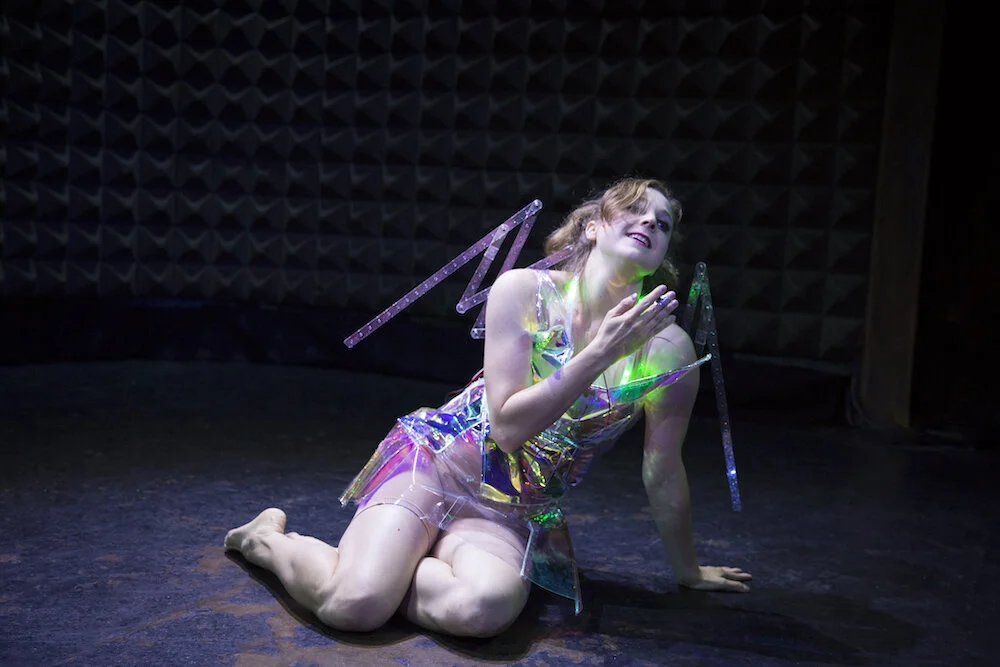


“Babyface is blunt with its spectacle as a pathway to its own subversion. An essential motivating question throughout our process was: how do we get audiences past the initial moment of, “oh my god, it’s a robot on stage!” and therefore able to engage with our higher level concepts? Our answer was to fully embrace this moment. If we can first confront audiences with a familiar, predictable stereotype (robot barbie with segmented motion and a fixed smile), we can then reveal the shortcomings of that stereotype (the struggle against aesthetic restriction and the vulnerability that comes with being on display).”
Babyface: Performance and Installation Art Exploring the Feminine Ideal in Gendered Machines
in Frontiers Special Edition The Art of Human-Robot Interaction: Creative Perspectives from Design and the Arts
Project Collaborators
Choreography by Kate Ladenheim, with Amy LaViers
Machine by Amy LaViers and Wali Rizvi, with Kate Ladenheim
Costume by Reika McNish and Christy Hauptman
Music by Myles Avery
Dancers: Kate Ladenheim, Olliver Carruthers, Sebastian Geilings, Rosie Tapsell, & Cheyanne Teka from Footnote New Zealand Dance.
Presentation History
Joe’s Pub at the Public Theater, DanceNOW [NYC]
The Performance Arcade [New Zealand]
AWMAS Conference at UCSB [Santa Barbara]
Human Robot Interaction Conference 2020 [Virtual]
Conference on Movement and Computing 2020 [Virtual]
Funding + Support
The Performance Arcade
US Embassy, New Zealand
The Robotics, Automation, and Dance (RAD) Lab
University of Illinois at Champaign Urbana.